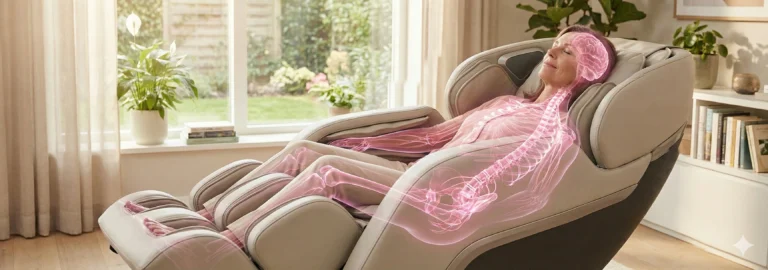


A 5D massage chair is an advanced therapeutic device that utilizes a continuous digital feedback loop to monitor and adjust the position and intensity of the massage rollers in real-time based on the user’s muscle stiffness and body contours.
Summary
- Real-Time Feedback: Unlike previous generations, 5D technology involves a constant communication loop between the massage mechanism and the chair’s processor, allowing for instantaneous adjustments to pressure.
- Beyond Rhythm: While a 4D massage chair introduces speed and rhythm variations, 5D adds the element of “sensing,” ensuring the rollers maintain consistent, effective pressure even as they traverse complex body curves.
- Pioneered by Panasonic: Although the term “5D” is a relatively new marketing descriptor, legacy Japanese manufacturers like Panasonic have utilized this sophisticated feedback technology in their RealPro Ultra mechanism for years.
- Precision Therapy: The primary benefit of 5D massage rollers is the ability to replicate the nuanced touch of a human therapist who can feel muscle tension and adjust their technique accordingly.
The Evolution of Massage Dimensions
To truly understand the sophistication of a 5D massage chair, one must first understand the progression of massage chair technology. As the industry has advanced, manufacturers have used “dimensions” to describe the range of motion available to the massage mechanism.
The Foundation: 2D and 3D Massage Chairs
The earliest modern massage chairs utilized a 2D massage chair mechanism. In this design, the rollers move on an X and Y axis—up and down the back, and side to side. While effective for basic surface massage, 2D rollers cannot extend forward or retract; they remain on a flat plane.
The industry later introduced the 3D massage chair, a significant leap forward in therapeutic capability. A 3D mechanism adds a Z-axis, allowing the rollers to extend deep into the muscle tissue and retract back into the chair. This allows the user to control the intensity of the massage by adjusting how far the rollers press into the back, creating a true deep-tissue experience.
Adding Rhythm: The 4D Massage Chair
Building upon the depth control of 3D, a 4D massage chair incorporates the element of timing and rhythm. In a 4D mechanism, the rollers can speed up and slow down mid-stroke. This variation in speed mimics the natural movements of a human therapist, who might move quickly to warm up a muscle and slow down to work out a specific knot. You can read more about these differences in our guide to 3D vs 4D Massage Chairs.
Quick Comparison: 2D vs. 3D vs. 4D vs. 5D
| Dimension | Movement | Key Benefit | Best For |
| 2D | X (Width), Y (Height) | Simple, surface-level massage | Casual relaxation; budget-friendly options |
| 3D | + Z (Depth) | Adjustable intensity and deep tissue capability | Users needing stronger, targeted pressure |
| 4D | + Speed/Rhythm variation | Natural, human-like tempo changes | Those seeking a realistic, fluid massage experience |
| 5D | + Real-time Feedback/Sensing | Consistent pressure across all body curves | Therapeutic precision, injury sensitivity, and pain management |
Defining 5D: The Feedback Loop
If 4D is about rhythm, 5D is about reaction.
The specific definition of a 5D massage chair centers on a high-speed feedback loop between the massage rollers (the hardware) and the chair’s central processor (the software). In lower-dimensional chairs, the rollers execute a pre-programmed movement pattern regardless of the resistance they meet.
In a 5D system, the chair “feels” back. As the rollers press into the muscle, the mechanism detects resistance caused by muscle stiffness or the curvature of the spine. This data is sent to the processor, which instantly adjusts the torque, depth, and position of the rollers. This ensures that the intensity remains uniform, even as the rollers move from the broad, flat muscles of the back to the intricate curves of the neck and shoulders.
According to the National Center for Complementary and Integrative Health, massage therapy is effective for managing pain and promoting relaxation. 5D technology maximizes these benefits by ensuring the massage is applied with consistent therapeutic pressure, avoiding the discomfort of rollers pressing too hard against bone or too lightly against deep muscle tissue.
What 5D Is Not
There is significant confusion in the market regarding high-tech features. It is important to clarify that 5D does not simply refer to the presence of brushless motors, nor does it refer to general “AI” marketing buzzwords. While high-quality motors are required to execute 5D movements, the definition lies strictly in the sensing and adjusting capability of the mechanism.
The Panasonic Legacy
While “5D” is a popular term in today’s market, the technology itself is not new to the world’s most advanced engineers. Panasonic massage chairs, a staple of the Furniture For Life collection, pioneered this technology long before the term “5D” existed.
Panasonic’s proprietary RealPro Ultra mechanism is arguably the truest and most sophisticated iteration of 5D technology available. Utilizing motor current feedback to sense pressure, their engineers designed a system where the roller intensity is sampled and adjusted up to 100 times per second. This allows Panasonic chairs to execute intricate, micro-movements that other chairs cannot replicate. When you experience a Panasonic chair, you are experiencing the benchmark of 5D precision.
Benefits of 5D: Who Needs It?
The human body is not a flat surface; it is a complex landscape of varying densities and curves. A massage mechanism that cannot adapt to these variances risks being ineffective or even painful.
For Users with Injury Sensitivity For those managing chronic pain or recovering from injuries, standard deep-tissue chairs can sometimes feel too aggressive or “sharp.” 5D technology solves this by detecting resistance. If the rollers encounter a guarded or sensitive area, the feedback loop instantaneously adjusts the pressure, ensuring the massage relieves tension without causing defensive splinting or pain.
For Deep Tissue Without the Pain Users seeking deep tissue work often face a trade-off: to get the depth they need in large muscle groups, they must endure painful pressure on bony areas like the spine or shoulder blades. 5D sensors eliminate this compromise. The chair maintains deep, effective pressure in the muscle belly but automatically retracts slightly when sensing the density of bone, delivering a potent massage that remains comfortable and safe.
By utilizing 5D feedback, a chair can safely navigate delicate areas like the cervical spine and the shoulder blades. This precision contributes to the reduction of stress and anxiety, which the Mayo Clinic notes is a key benefit of massage, alongside improved circulation and immune function.
Investing in a chair with this level of responsiveness ensures that your daily wellness routine is not just a mechanical process, but a personalized therapeutic interaction.
FAQ
Is a 5D massage chair better than a 4D massage chair?
Generally, yes. While a 4D chair offers excellent rhythm and speed variation, a 5D chair adds a layer of intelligence that adjusts pressure in real-time. This results in a smoother, more consistent, and more human-like massage experience.
Does Panasonic make 5D massage chairs?
Yes. In fact, Panasonic is a pioneer of the technology that “5D” describes. Their RealPro Ultra mechanism utilizes high-frequency feedback loops to adjust pressure instantly, making them some of the most advanced 5D chairs on the market, even if they don’t always use that specific label.
Do I need a 5D massage chair for deep tissue massage?
Not necessarily. A high-quality 3D or 4D chair can provide a very strong deep-tissue massage. However, 5D technology ensures that the deep tissue pressure is applied more accurately and consistently across different contours of your body.
Is 5D the same as AI in massage chairs?
Not exactly. While some brands use “AI” as a catch-all term, true 5D refers specifically to the feedback loop between the rollers and the motor to adjust intensity. AI often refers to body scanning and algorithm selection, whereas 5D is the mechanical execution of real-time pressure adjustment.