
Calf Massagers: Benefits, How They Work, and Why a Massage Chair Does It Better
-
 Created By
Charles Stanley

Published on November 6, 2026.
Share this article:
A calf massager uses air compression, kneading rollers, or heat to work the lower-leg muscles that act as the body’s “second heart.” Standalone devices deliver one of those mechanisms to one body region, while a full-body massage chair delivers all three to the calves in synchrony with the back, hips, and feet, with the legs elevated in zero gravity where circulation benefits most.
Summary
- The calf muscles form a venous pump (vascular specialists call them a “second heart”), and every contraction pushes blood from the lower legs back toward the torso, which is why the calves respond so strongly to massage.
- Calf massage supports circulation, eases the heaviness of standing workdays and long travel, helps muscles recover after exercise, and relaxes a region most people chronically neglect.
- The technology behind every calf massager comes down to three mechanisms: sequential air compression, mechanical kneading, and heat. The most effective therapy combines all three and adds elevation.
- Furniture For Life does not sell standalone calf massagers. Every full-body massage chair in our collection includes engineered calf therapy in the leg ottoman, which is the position this guide argues the feature belongs in.
- People with vein disease, a history of blood clots, diabetes-related sensation loss, or any diagnosed circulatory condition should ask their physician before using mechanical massage on the calves.
Few muscle groups work harder and receive less attention than the calves. They stabilize every step, absorb the load of standing professions, and quietly perform a circulatory job the rest of the cardiovascular system depends on. That combination of constant work and chronic neglect explains the growing interest in calf massage, and it deserves an honest guide. This one explains the real calf massager benefits, the technology behind the category, who gains the most from it, and why the most complete version of this therapy is built into a full-body massage chair rather than strapped on as another gadget. One point of transparency up front: we don’t sell standalone calf devices, so this guide has no device to push, only the case for where calf therapy works best.
Why the Calves Deserve Daily Attention
The gastrocnemius and soleus muscles do more than power your stride. Together they form the calf muscle pump: each contraction compresses the deep veins of the lower leg and pushes blood upward, against gravity, toward the heart. Peer-reviewed vascular research published in The International Journal of Angiology describes the calf pump as the motive force of venous circulation in the lower limb, which is why clinicians often call the calves a “second heart.” When the calves sit idle through a desk day, a flight, or hours behind a counter, that pump barely runs, fluid pools in the lower legs, and the familiar heaviness, mild swelling, and end-of-day leg fatigue follow.
Massage addresses the problem at its source. Rhythmic external pressure mimics the calf’s own pumping contraction, encouraging venous return and helping move accumulated fluid out of the tissue. The National Center for Complementary and Integrative Health (NCCIH) summarizes the clinical evidence for massage cautiously, citing modest and often short-term benefits for some types of pain, and that sober baseline is the standard this guide holds itself to: calf massage treats tired legs and everyday comfort, not disease.
There is also a whole-body dimension that a lower-leg-only view misses. The calves tighten in chains: restricted calves alter ankle mechanics, which changes gait, which loads the knees, hips, and lower back. Treating the calves in isolation relieves the symptom; treating them as part of the posterior chain, which is what a full-body program does, addresses the pattern.
How Calf Massage Technology Works
Every calf massage device on the market, from budget sleeves to the leg ottoman of a premium massage chair, relies on some combination of three mechanisms. Understanding them makes the whole category easy to decode.
Sequential Air Compression
Air chambers surround the calf and inflate in a programmed sequence, typically from the ankle upward, squeezing the muscle the way a therapist performs a milking stroke. Compression is the mechanism aimed most directly at circulation, because the sequential pressure physically moves pooled fluid in the direction the venous system wants it to go. This is the same principle athletic recovery systems use, and it is why compression is the backbone of any serious calf program.
Mechanical Kneading
Where compression works on fluid, kneading works on the muscle tissue itself. Motorized rollers or shiatsu-style nodes press into the gastrocnemius and travel along it, loosening tightness, releasing tension near the Achilles insertion, and desensitizing the trigger points that build up from training and long days on your feet. Kneading is what makes calf therapy feel like massage rather than a blood-pressure cuff.
Heat
Warmth increases tissue elasticity and dilates surface blood vessels, so heated programs feel deeper at the same mechanical intensity, and the muscle accepts more work. On its own, heat is a comfort feature; layered under compression and kneading, it measurably improves what the mechanical therapy accomplishes. In our collection, heat therapy extends well beyond the calves. The approach is explained in our heated massage chair collection.
The Fourth Ingredient: Position
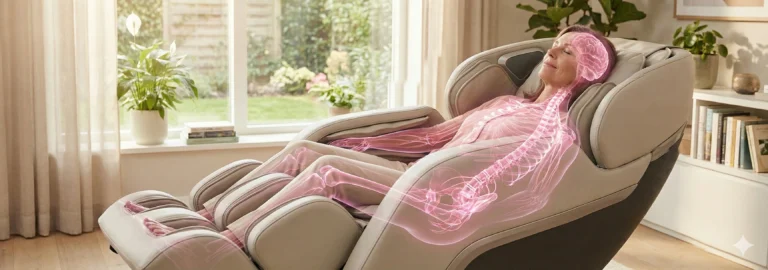
One mechanism no stand-alone calf massage device offers is elevation. Raising the legs to heart level or above lets gravity assist venous drainage instead of fighting it. That is the exact position a zero gravity massage chair reclines into. Compression, kneading, and heat applied while the legs are elevated all work in the same direction as the circulation they are trying to support.
One rule ties all three mechanisms together: good calf massage works toward the heart. That is why compression sequences inflate from the ankle upward and why manual technique strokes up the calf, never down. The direction of the therapy follows the direction of venous return.
“The calf responds best to sequenced therapy: warm the tissue, compress from the ankle upward, then knead, ideally with the legs elevated. Any single mechanism alone leaves part of the job undone, which is why a chair’s leg system outperforms a device you use sitting upright.”
Why Calf Massage Feels So Intense
Two of the most-asked questions about calf massage are opposites: why it feels so good, and why it sometimes hurts. Both have the same answer. The calves spend all day under load or going un-exercised, and rarely get stretched or treated, so they accumulate tightness and trigger points; when massage finally reaches that tissue, the release registers as intense: deeply satisfying on a healthy muscle, tender where knots have built up. Start at a lower intensity and let the tissue adapt over the first week of sessions: normal massage discomfort fades as tightness releases, while sharp or lingering pain is a signal to stop and, if it persists, ask a professional. Chronically tight calves also feed problems downstream. They are a commonly cited contributor to plantar fasciitis and Achilles strain, which is why calf work often appears in self-care plans for both (with your clinician’s guidance, per the safety section below).
Who Benefits Most from Calf Massage
Standing and Walking Professions
Nurses, teachers, retail and warehouse staff, chefs, and anyone else logging six or more hours upright, accumulate exactly the lower-leg fluid load that sequential compression is designed to move. A 15-minute session at the end of a shift targets the tissue where the day settled.
Runners and Active Adults
The calves absorb a disproportionate share of running and jumping load, and delayed-onset soreness collects there accordingly. The Mayo Clinic notes that massage can help reduce stress, pain, and muscle tension, and recovery is where daily, zero-effort access matters most, because the therapy you actually do beats the therapy you occasionally set up.
Desk Workers and Frequent Travelers
Prolonged sitting idles the calf pump just as thoroughly as standing overloads it. Regular calf massage, paired with movement breaks, helps counter the heaviness of sedentary days. After long flights, elevation plus compression is precisely the combination the lower legs are asking for.
Older Adults
Circulatory efficiency declines with age, which makes the calf pump’s assistance more valuable, not less. For seniors, the practical advantages of getting calf therapy from a massage chair are worth naming plainly: no bending down to strap a device on, no separate gadget to manage, and programs that treat the back, hips, feet, and calves in one seated session. The same guidance applies with extra force here: anyone managing a vascular condition or on blood thinners should clear mechanical massage with their physician first.
Standalone Calf Massagers vs. a Massage Chair’s Leg System
Standalone devices are a legitimate category, and this comparison treats them fairly. But the differences are structural, not incremental:
| Standalone calf device | Massage chair leg system | |
| Mechanisms | Usually one (compression or rollers); heat on some models | Compression + rollers + heat together, program-controlled |
| Body position | Seated upright; legs hang down against gravity | Reclined, with zero gravity elevation at or above heart level |
| Coverage | Calves only (some add feet) | Calves, feet, and the entire posterior chain in one session |
| Synchronization | Isolated from the rest of the body | Choreographed with back and hip massage as one kinetic chain |
| Effort and consistency | Retrieve, strap on, sit, put away, every time | Sit down; therapy is part of the daily full-body routine |
| Role in the home | One more single-purpose gadget | One piece of furniture covering the whole job |
The pattern in that table mirrors what we found comparing foot devices in foot massagers vs. massage chairs: single-region devices do one thing acceptably, and a full-body system does that same thing as one component of something larger.
Calf Therapy Inside a Massage Chair: What You Actually Get
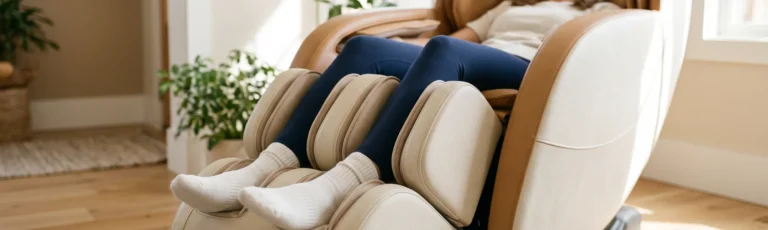
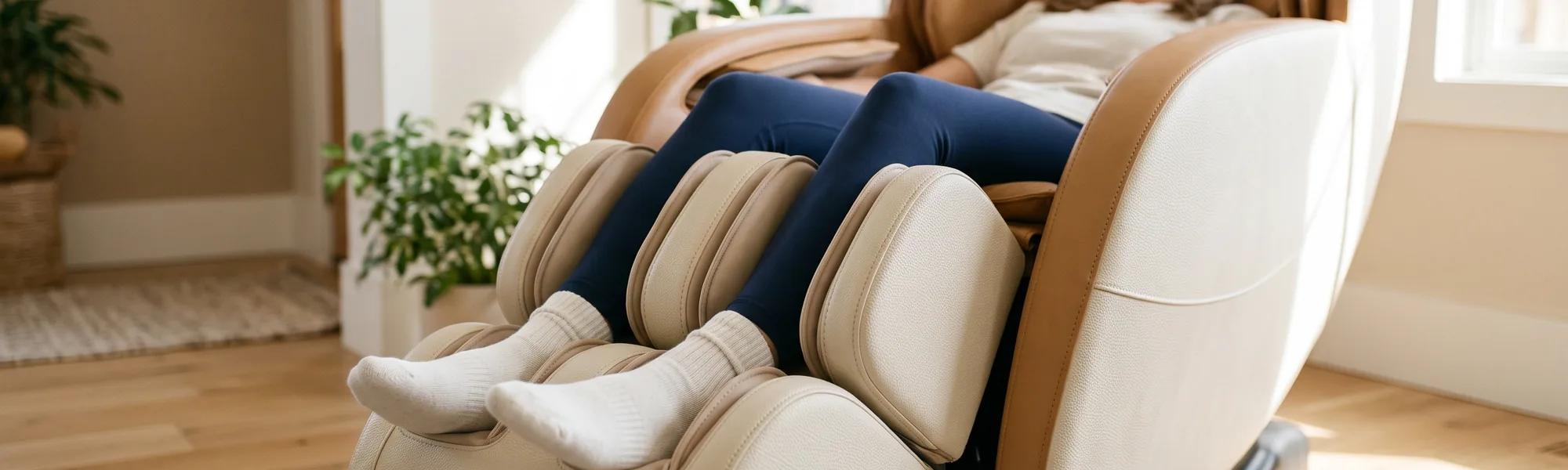
Furniture For Life does not sell standalone calf massagers by design. Every chair in our collection builds calf therapy into the leg ottoman, because that is where the four ingredients (compression, kneading, heat, and elevation) can finally operate together. Here is what to evaluate in a chair’s leg system, whichever brand you consider:
- Airbag architecture: multiple chambers per calf that inflate sequentially (ankle upward), not a single bladder that merely squeezes.
- Rollers in the leg well: kneading nodes for the calves, plus underfoot rollers, rather than compression alone.
- Heat coverage: whether warmth reaches the calves and feet, not just the lumbar region.
- Ottoman adjustment: an extending ottoman that matches your leg length, so the airbags land on the muscle instead of the ankle or knee.
- Zero gravity recline: the position that elevates your legs to heart level while the calf program runs.
- Program intelligence: body scanning and full-body choreography, so calf therapy runs in sequence with the spine and hips instead of in isolation.
Through the curated collection at Furniture For Life, home to The World’s Best Massage Chairs®, every full-body massage chair includes engineered calf therapy, from sequential airbag compression with heat to leg wells that add kneading rollers, across a range of $1,999 to $18,000 with 0% financing from about $111 per month. Every purchase includes white glove installation, in-home warranty service, and a 90-day in-home trial, and each model can be tested at one of our 30 U.S. showrooms.
Safety: When to Ask a Doctor First
Mechanical calf massage is designed for healthy muscles and healthy veins, and the honest guide says so clearly. Check with your physician before using any calf massage program, standalone or in a chair, if any of the following applies:
- A history of blood clots or deep vein thrombosis (DVT). Mechanical pressure over compromised deep veins is a medical decision, never a comfort decision.
- Significant varicose veins or diagnosed venous insufficiency. Gentle programs may be fine; your doctor decides, not a product page.
- Diabetes with reduced sensation in the lower legs. If you cannot fully feel pressure and heat, intensity settings need medical guidance.
- Pregnancy. Positions and programs deserve a conversation with your OB-GYN first. Our guide to massage chairs and pregnancy safety covers what to discuss.
- Recent injury or surgery on the leg. Wait for clearance.
For everyone else, moderate intensity and sensible session lengths are the rule. Can is the operative word throughout this article: massage can help support circulation and recovery, but it treats tired legs, not vascular disease.
How Often, How Long
Consistency beats intensity. For healthy adults, 10 to 20 minutes at moderate intensity, up to once or twice daily, is the commonly recommended starting routine: after the standing shift, after the run, or in the evening wind-down. Inside a massage chair routine, the calves simply ride along with the full-body session, which is the quiet advantage: the region most people neglect gets treated every single day without a separate decision. If you are new to regular massage sessions, our overview of whether massage chairs are good for you covers frequency, benefits, and who should check with a doctor first.
FAQ: Calf Massage
What are the benefits of using a calf massager daily?
Daily calf massage supports circulation through the calf muscle pump, eases the heaviness that follows long periods standing or sitting, and helps muscles recover after exercise. Consistency matters more than intensity: 10 to 20 minutes at a moderate setting is the commonly recommended routine for healthy adults.
Why do calf massages hurt so much, or feel so good?
Both reactions come from the same physiology: the calves carry load all day and accumulate tightness and trigger points, so massage lands on tissue that badly needs the work. On a healthy muscle that release feels unusually satisfying; where knots have built up, it can be tender at first. Start at lower intensity and let the tissue adapt. Normal massage discomfort eases within the first sessions, while sharp or persistent pain means stop and check with a professional.
Is calf massage good for circulation?
It can help support it. The calves naturally pump venous blood toward the heart, and rhythmic external compression mimics that action, with the effect strongest when the legs are elevated, as in a zero gravity recline. People with a diagnosed circulatory condition, clotting disorder, or significant varicose veins should get a physician’s approval first.
Do massage chairs massage your calves?
Yes. Full-body massage chairs include a leg ottoman with sequential airbags for the calves, and premium models add kneading rollers, foot rollers, and heat. The calf program runs in choreography with the back and hip massage, and in zero gravity recline the legs are elevated to heart level while it works.
Do I need a separate calf massager if I have a massage chair?
No. A chair with a well-engineered leg system already delivers compression, kneading, and heat to the calves (the same mechanisms standalone devices offer individually), plus the elevated positioning and full-body synchronization no standalone device can provide.
Conclusion & Next Steps
The calves earn their “second heart” name every day, and they respond to massage as reliably as any muscle group in the body. The question is not whether calf massage is worth having. It is where that therapy belongs. Delivered by a single-purpose device, it treats one region while you sit upright against gravity. Built into a full-body massage chair, the same compression, kneading, and heat arrive synchronized with the rest of the body, with your legs elevated where circulation benefits most, every single day. Explore the full massage chair collection or visit a Comfort Consultant at one of our 30 U.S. showrooms. Bring your tired calves, try the zero gravity leg program in person, and judge the difference yourself.
Related Topics

Charles Stanley
Marketing Director
Charles is the Director of Marketing for Furniture For Life Massage Chairs. As a frequent contributor to the Furniture For Life blog, he is dedicated to helping shoppers make well-informed decisions to improve their health, wellness, and happiness by providing insights into massage chair benefits, technology, and functionality.
-
Cliff Levin

Read the Body Massager Guide >
-
Charles Stanley
Explore Foot Massagers & Chairs >
-
Charles Stanley
Find Fibromyalgia Relief >
Step into one of our showrooms and feel the difference for yourself. Sit back, relax, and discover what true comfort really means.
- Chat with us